The phrase "the war is over" has a long and unbroken record of being spoken too soon.
Neville Chamberlain spoke of "peace in our time" in September 1938, waving his signed agreement before a cheering crowd in London. The Greeks assembled at the Congress of Sparta in 432 B.C. assured themselves that Athenian ambition had reached its natural boundary. The Roman Senate in the late fourth century continued to expand its bureaucracy and its dole while its legions thinned on the frontiers — confident, as Gibbon would later observe, that the arrangement could hold indefinitely.
None of them were wrong about their desire for peace. All of them were wrong about whether their adversary shared it.
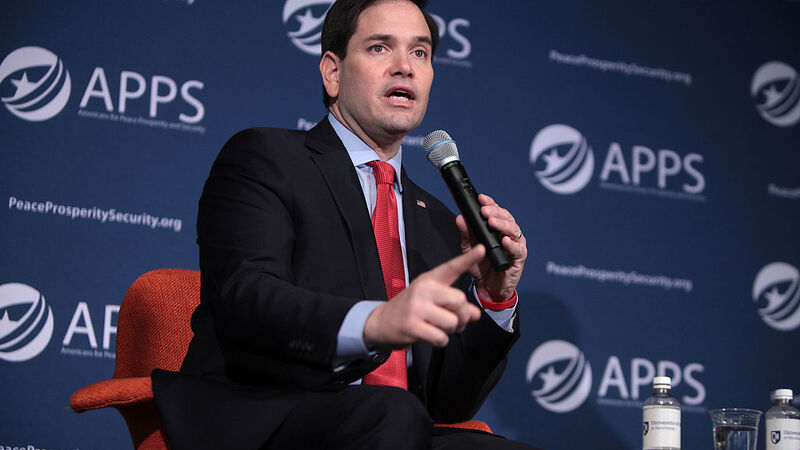
Secretary of State Marco Rubio declared Tuesday that the Iran war is "over now." He said it with evident conviction, laying out Washington's terms for a broader framework: no nuclear weapons program, no continued ballistic missile threats to American allies, a pathway that could — if respected — lead to sanctions relief and eventual normalization. These are not unreasonable terms. They reflect a genuine and legitimate American interest in regional stability.
But within the same news cycle — as if the ancient ironies of statecraft were offering their own editorial — Iran launched drone and missile attacks against Kuwait and Bahrain, among the most destructive strikes since the April ceasefire. U.S. Central Command confirmed the attacks and reported that American forces had fired a Hellfire missile at an Iranian tanker approaching Kharg Island, Iran's principal oil terminal, after the vessel ignored repeated warnings to stand down.
This is not a new story. It is the oldest problem in the history of foreign affairs: what happens when one civilization decides the war is over, and the other has not received the message — or more precisely, has received it and chosen to treat it as an opportunity.
Thucydides diagnosed this dynamic with characteristic precision in his account of the Melian Dialogue. The Athenians, at the height of their imperial confidence, told the Melians plainly: "the strong do what they can and the weak suffer what they must." But Athens itself soon discovered that strength without prudence is not strategy — it is hubris dressed in armor. The Sicilian Expedition, launched in overconfidence, concluded in catastrophe, and the Athenian empire never recovered its former height. Strength without wisdom dissipates. Nations that mistake their own declarations for strategic reality tend to discover the error at great cost.
The Founders were students of classical history precisely because they understood that the fundamental patterns of power do not change across centuries. What changes is the technology, the geography, the particular cast of players. What does not change is the basic dynamic between a civilization that desires peace and a regime that desires dominance — and has learned to speak the language of peace as a tool for buying time and space to maneuver.
Iran has been doing exactly this for forty-six years.
Since the Islamic Revolution of 1979, the leadership of the Islamic Republic has made no serious effort to conceal its ultimate intentions. Its founders declared America the Great Satan. Its Revolutionary Guards took American diplomats hostage for 444 days. Its proxy Hezbollah bombed the Marine barracks in Beirut in 1983, killing 241 American servicemen in what remains one of the deadliest single-day attacks on American military personnel since the Second World War. Iran armed and funded Hamas, Islamic Jihad, and a web of Shiite militias across Iraq, Syria, and Yemen. It pursued a nuclear program in defiance of every diplomatic agreement it signed and then violated.
What the Islamic Republic has always understood — and what Washington periodically forgets — is that ceasefire agreements mean fundamentally different things to different parties. To a Western democratic government, a ceasefire represents a genuine breathing space on the road to a political settlement. It carries moral weight. It is meant to hold. To the Islamic Republic of Iran, a ceasefire is a tactical interval — time to regroup, rearm, assess the adversary's resolve, and probe the edges of the agreement to determine how much pressure the other side is actually willing to bear.
The attacks on Kuwait and Bahrain were not random escalations. They were a probe. The question Tehran is asking, through the language of drones and missiles, is the same question adversarial powers have always asked in the aftermath of agreements with democratic nations: does this ceasefire represent a genuine settlement, or does it represent exhaustion? Are these terms backed by political will — or are they a form of face-saving that can be tested until they collapse?
Secretary Rubio is not wrong to pursue a diplomatic framework. The Trump administration's approach — using military leverage to create negotiating space, laying out non-negotiable terms clearly, engaging directly — is a serious strategy and a reasonable response to a genuinely difficult problem.
But Tocqueville warned, in his study of democratic governance, that self-governing peoples are constitutionally prone to premature declarations of victory. The virtues that make democracy powerful — accountability, responsiveness to public opinion, the rooting of policy in the desires of real citizens who want commerce and family life and stability — also make democratic governments susceptible to announcing peace before it has been achieved. The people want the war to be over. The statesman says that it is. The adversary notices the space between the announcement and the reality.
The permanent things do not change. Nations that are not serious about their own survival tend, over time, not to survive. Nations that confuse the desire for peace with its achievement invite the very conflicts they are trying to avoid.
Rubio says the war is over. The drones are still flying. American warships are still firing on Iranian tankers. Kuwait and Bahrain are tallying damage.
The distance between "the war is over" and the actual cessation of Iranian aggression is exactly where American credibility lives or dies in the Persian Gulf.
History does not ask whether we wanted peace. It asks whether we were serious about it — serious enough to ensure that our adversaries believed the cost of violation was real.
The answer, in the months to come, will tell us everything we need to know about what kind of civilization we intend to be.
Rubio Says the War Is Over. Tehran Just Hit Kuwait and Bahrain. History Has Seen This Before.
- by: Cole Ryder
- 06.04.2026
- Source:
fafodispatch.com

- 06/04/2026
