Supreme Court Rules Unanimously: Habitual Marijuana Use Is Not Grounds to Strip Gun Rights
- by: Cole Ryder
- 06.18.2026
- Source:
fafodispatch.com

- 06/18/2026
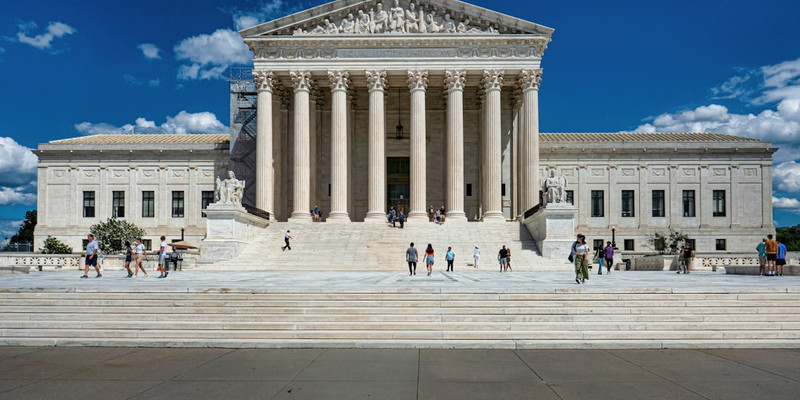
a group of people standing in front of a building by Stephen Talas is licensed under Unsplash unsplash.com
WASHINGTON — The Supreme Court on Thursday unanimously struck down a federal law that banned habitual marijuana users from owning firearms, ruling the statute unconstitutionally deprived individuals of their Second Amendment right to keep weapons in their homes.
The ruling, authored by Justice Neil Gorsuch, found that the government's prosecution under 18 U.S.C. § 922(g)(3) — which prohibits persons who are "unlawful users" of controlled substances from possessing firearms — exceeded constitutional limits as applied to marijuana users.
The case originated in Texas. FBI agents raiding a man's home discovered a handgun he kept for self-defense. When questioned, the man acknowledged he smoked marijuana every other day. He was charged with a federal felony solely on that basis.
The court found the prosecution unconstitutional. "Marijuana use today is like alcohol use at the founding," the ruling noted, applying the historical analysis required under the court's 2022 precedent in New York State Rifle & Pistol Association v. Bruen, which requires that gun regulations be "consistent with the Nation's historical tradition of firearm regulation." The court found no historical analogue sufficient to sustain the law as applied.
The ruling was nine to zero. All six conservative and three liberal justices joined the majority opinion.
The decision has direct implications for millions of Americans. Marijuana has been legalized or decriminalized under state law in more than 40 states. Under federal law, however, marijuana remains a Schedule I controlled substance. Under § 922(g)(3), marijuana users in legal-use states have technically remained ineligible to possess firearms — a prohibition federal prosecutors have applied inconsistently but which has resulted in criminal charges in numerous cases.
The same statute formed a basis for the federal prosecution of Hunter Biden, son of former President Joe Biden. Biden was convicted and sentenced following a widely covered trial in Delaware. Thursday's ruling calls the statutory underpinning of that conviction into constitutional question. The court's opinion did not directly address the Biden case, but defense attorneys handling similar pending prosecutions are expected to move for dismissal based on the ruling.
Justice Gorsuch's majority opinion applied the Bruen framework — examining whether historical regulation at the founding era supports the challenged statute — and found the government's position wanting. Federal prosecutors had argued that the combination of drug use and firearm possession presented a public safety danger the founders would have recognized. The court rejected that argument.
The Department of Justice did not respond to a request for comment Thursday afternoon regarding the ruling's implications for pending prosecutions under the same statute.
Thursday also produced a second major Second Amendment ruling at the state level. A Florida appeals court ruled unanimously that the state's ban on concealed carry permits for adults between the ages of 18 and 20 violates the Second Amendment. The Florida court described the restriction as "a burden that is facially unconstitutional" and found no historical basis for treating 18-to-20-year-olds differently from other adults in the exercise of Second Amendment rights.
The Florida decision adds to a growing body of lower-court rulings applying the Bruen standard to strike down age-based and use-based firearms restrictions. Legal analysts said Thursday that the Supreme Court's marijuana ruling will accelerate that trend in lower courts across the country.
The Texas case will return to lower courts for proceedings consistent with the Supreme Court's ruling.
What comes next: Congress has not issued formal statements on the ruling. Senate Republicans are focused this week on the Iran MOU and FISA 702 reauthorization. Whether the DOJ moves to narrow its use of § 922(g)(3) in light of the ruling — or awaits additional guidance — remains an open question.
