For years, E. Jean Carroll was untouchable.
She was presented by the media, by legal commentators, by the Democratic Party establishment as a credible and protected figure — someone whose accusations against Donald Trump were beyond question, whose motives were beyond examination, and whose legal victories over the former president were cause for celebration in the pages of every major publication that claimed to speak for the American mainstream.
That era is apparently over.
The Department of Justice has opened a criminal investigation into E. Jean Carroll. Multiple reports this week, citing anonymous sources familiar with the matter, confirmed that the investigation is underway. The same Justice Department that four years of Democratic governance treated as a guardian of impartial law has now turned its attention toward the woman whose accusations were treated as political gospel.
Think about what that actually means.
Criminal investigations at the federal level don't open themselves. Career prosecutors — the same kind of attorneys the press spent years celebrating for their independence — don't expend institutional resources on targets without a factual predicate. You don't open a criminal probe of a private citizen because you disagree with her politics or because she embarrassed someone you like. You open one because something is there.
Nobody in the press will say that plainly. What you'll hear instead is the predictable framing: this is retaliation, this is political, this is the administration weaponizing justice. The same journalists who spent years insisting the DOJ was weaponized under Biden will now insist that scrutiny of Carroll is evidence of that same sin.
Ask yourself why.
Carroll accused Trump of sexually assaulting her in a Manhattan department store dressing room sometime in the mid-1990s — a claim she made public decades after the alleged incident. She sued him twice: once over the original accusation, once over defamation after Trump denied it. Courts awarded her damages. The press declared the matter settled.
Except the DOJ doesn't appear to agree.
What changed? We don't know yet. The investigation is in its early stages, and the specific criminal predicate that prompted it hasn't been publicly disclosed. What we do know is that someone with direct knowledge of the investigation chose to speak to the press — which means the probe has enough substance and internal momentum that it produced leaks. Investigations that go nowhere don't generate sources willing to take that risk.
The ruling class spent years constructing a legal and media fortress around E. Jean Carroll. Her lawsuits against Trump were crowdfunded, championed, and covered as morality plays in which the brave victim confronted the powerful abuser. Journalists who questioned any element of her account were denounced. Legal experts who raised procedural concerns were dismissed.
The regime doesn't protect people out of principle. It protects them because they're useful.
When the utility ends, the protection ends with it.
This is precisely the pattern that characterized two-tier justice for the past decade. It wasn't that the law happened to produce outcomes favoring the establishment's allies. It was that the law was applied selectively — aggressively against those who challenged the ruling class, gently toward those who served it. Four federal indictments of the leading Republican presidential candidate. Pre-dawn raids. Grand jury subpoenas of political allies and attorneys.
And E. Jean Carroll, celebrated at events, given platforms, presented as a symbol.
That asymmetry is now being examined by the same institution that enforced it. The DOJ that spent years as a political instrument is now applying at least some portion of its attention to one of the left's most prominent protected figures. Whatever the investigation reveals — and we will know more as it develops — its existence alone is significant.
It means nobody is permanently untouchable.
It means the system, however slowly and imperfectly, is capable of turning its attention in directions the establishment does not approve of. It means that the legal infrastructure built to protect certain people can be redirected.
The press will not frame it that way. They will spend the next weeks defending Carroll with the same energy they spent defending the architecture of selective prosecution. They will not ask the question that matters most.
What did they know about her, and when did they know it?
That's the question the DOJ is now apparently asking. The rest of us should pay close attention to the answer.
The DOJ Is Investigating E. Jean Carroll. Nobody Thought That Was Possible.
- by: Cole Ryder
- 05.28.2026
- Source:
fafodispatch.com

- 05/28/2026
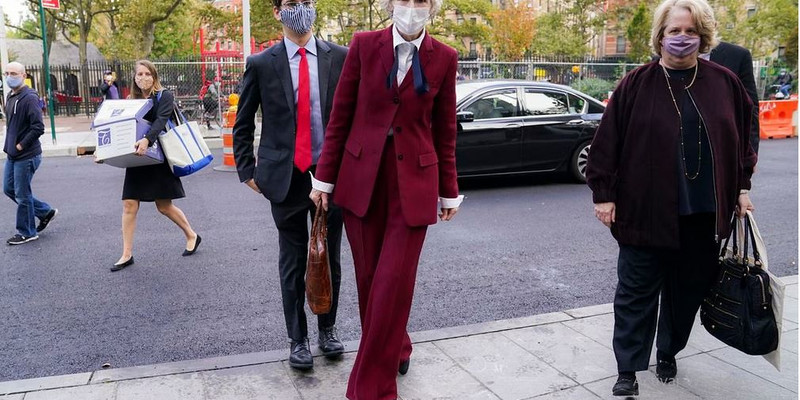
20230414_La defensa de E. Jean Carroll, se ha opuesto a las dos solicitudes y ha explicado en una moción este mismo jueves que la autora interpuso su demanda y que la financiación de gastos legales del empresario, que considera “irrelevante”, by rupertomiller@hotmail. 6672 6121 hijo 66852945 is licensed under OpenVerse cc0
