
Here's what happened Sunday morning, and most of the press is going to spend all day burying the lead.
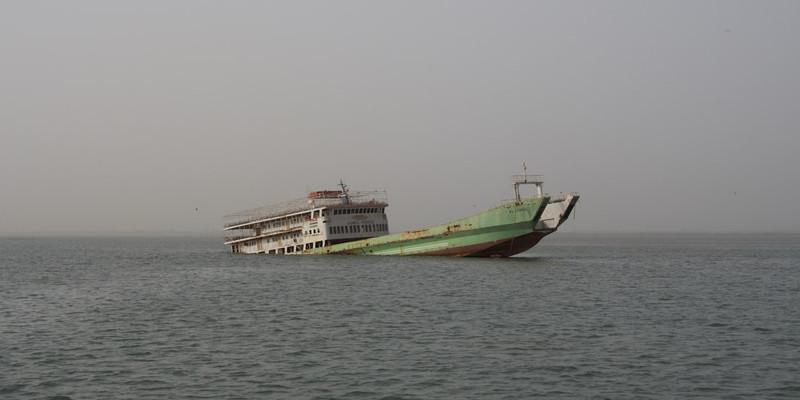
An Iranian cargo ship — 900 feet long, weighing almost as much as an aircraft carrier — decided to test the United States Navy's blockade of the Strait of Hormuz. The ship's name was the TOUSKA. It picked the wrong morning.
"We stopped them right in their tracks," President Trump announced, "by blowing a hole in the engineroom."
Then U.S. Marines rappelled aboard. The TOUSKA is now in American hands.
Think about what that actually means. A vessel flying an Iranian flag attempted to breach a military blockade drawn by the United States of America. We disabled the ship and boarded it. In international waters. In front of the entire world.
That's not a provocation. That's a country enforcing its word.
The question worth asking isn't whether this was the right call — that question answers itself. The real question is why Iran thought it could get away with trying. That question has a very specific answer, and the answer is uncomfortable for a lot of people in Washington.
Because for years, they could.
An entire generation of American foreign policy — spanning administrations of both parties — rested on the premise that Iran had to be managed, appeased, and engaged through layers of diplomatic process. We signed agreements they never intended to honor. We gave them cash on pallets flown in on unmarked planes in the middle of the night. We watched their proxies fire rockets into Israel, fund Hezbollah, arm the Houthis who were sinking shipping in the Red Sea. Every time something happened, the response from the foreign policy establishment was the same: restraint, back-channel dialogue, and a strongly worded statement from someone with a Georgetown PhD and a good haircut.
Ask yourself why.
Why would the most powerful military force in the history of human civilization spend decades communicating weakness to a regime that openly declares it wants us and our closest ally destroyed? The answer isn't complicated. The foreign policy establishment — the think tanks, the diplomats, the revolving-door consultants, the permanent national security bureaucracy — built careers around the premise that process could substitute for outcomes. Process justified their existence. Process kept them employed. Actual results were someone else's problem.
Nobody in that world told you that part.
The TOUSKA wasn't just an Iranian cargo ship trying to slip past a blockade. It was a test. Iran's leadership wanted to know whether this administration would respond the way every other administration responded: with phone calls and press releases and emergency consultations with allies who were themselves never going to do anything.
The Navy answered that question differently.
Now Tehran is threatening retaliation. Which is what Tehran always says. The Iranian government has been threatening retaliation since 1979. It's the same script every time — you have provoked us, consequences will follow, the Great Satan will face justice. The regime needs an external enemy to survive. An Iran without American aggression to blame is an Iran whose citizens start asking uncomfortable questions about why the economy has collapsed, why inflation is through the roof, and why the water doesn't run reliably in the capital.
The threats are real in the sense that Iran can cause damage. But they understand, better than anyone, what full-scale conflict with the United States looks like for them. That is a calculation they make every single time.
Meanwhile, Trump said Saturday that Iran "got a little cute" by trying to open and close the Strait of Hormuz. That is one way to describe it.
Here is another way: Iran is playing a negotiating game where one side has Marines and the other side has a ship with a hole in its engine room.
What happened Sunday morning matters because credibility matters. Every adversary watching this — in Beijing, in Moscow, in Tehran, in Pyongyang — is updating their assessment of what the United States is willing to do when it draws a line. For the better part of a decade, the correct update was: America draws lines and then explains, at length, why crossing them was understandable given the context. That calculus has changed.
You can debate the blockade policy. That's a fair conversation. What you cannot do is establish a military posture and then fold the moment it's tested. That's not restraint. That's an invitation.
Iran sent the TOUSKA. We sent the Marines.
That's the whole story.
