The Party That Killed Women's History
- by:
- 05.22.2026
- Source:
fafodispatch.com

- 05/22/2026
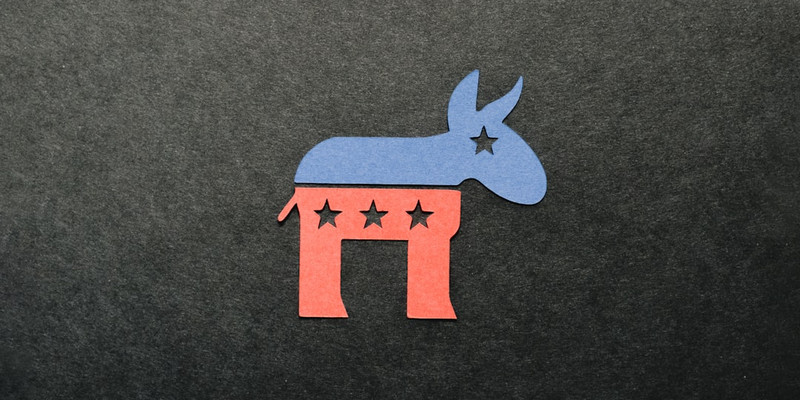
Symbol of Democratic party cut out of paper by Kelly Sikkema is licensed under Unsplash unsplash.com
There is a pattern observable across the long arc of revolutionary movements, from the Jacobins of revolutionary France to the ideological convulsions of the twentieth century, in which the very constituencies that gave a movement its moral energy are eventually consumed by the demands of ideological purity. Robespierre did not begin by targeting the Revolution's own champions. He ended there. The logic of total ideology, once released, cannot stop at convenient boundaries. It must move, and in moving, it eventually arrives at the founders.
On Thursday, the United States House of Representatives provided a striking contemporary illustration of this pattern.
The House considered legislation to establish a Smithsonian American Women's History Museum — a project that had been long sought, long debated, and long delayed. The bill's champions included Republicans. The legislation sought to honor, in permanent national form, the contributions of American women to the republic's history. It failed 216 to 204. Every Democrat in attendance voted against it. They were joined by six Republicans, though the Republicans' reasoning was distinct.
The cause of the Democratic revolt was a single provision added by Republican sponsors: the museum's exhibits would celebrate biological women, and the legislation would bar the institution from portraying males as female.
This is worth pausing over, because the civilizational implications are not small.
A party that for generations styled itself as the champion of women — that organized its coalition around women's advancement, women's rights, women's history — chose to kill a women's history museum rather than accept language affirming that women are, in biological fact, women. The amendment was not a theological assertion. It was not a partisan slogan. It was a statement of scientific and biological reality so elementary that it was, until approximately a decade ago, uncontroversial across the entire political spectrum.
What Alexis de Tocqueville observed about democratic societies — that they can be seized by a "soft despotism" of conformist opinion that enforces consensus through social pressure rather than overt coercion — finds its sharpest contemporary expression in exactly this kind of moment. No congressman who voted against this bill truly believes that the category "woman" is meaningless. What they believed, or feared, was that affirming the category would cost them. The ideology had moved far enough along that a vote for biological reality had become a vote against the movement.
This is not unprecedented in history. It is, in fact, one of the most familiar patterns in the long record of human political organization.
Thucydides, in his account of the Corcyrean revolution, observed how factional extremism destroys language itself — how words like "justice" and "loyalty" are redefined by parties until they no longer carry shared meaning, serving only as instruments of power. When a political party can no longer coherently define "woman," something analogous has occurred. The word has not vanished. It has been weaponized. To affirm its definition is to declare a side.
The founders of the American republic worried specifically about this kind of linguistic and civilizational decay. James Madison, in Federalist No. 10, warned against the faction that pursues its passion at the expense of "the permanent and aggregate interests of the community." A permanent national museum honoring American women's history is, by any reasonable definition, one of those aggregate interests — an acknowledgment that half the human race made contributions to this republic that deserve institutional memory. The Democratic Party declined to affirm this unless the definition of the honored class remained ambiguous.
The deeper irony is that women are the ones most directly harmed by this ideological capitulation. The women who fought for suffrage, for equal labor protections, for recognition in sciences and arts and letters — their history is a history of women as a distinct, identifiable class. Susan B. Anthony's struggle was not a struggle on behalf of an abstract category. It was a struggle on behalf of biological women, defined as such, excluded as such, and ultimately vindicated as such. To honor them in a museum while refusing to affirm what they were is not inclusion. It is erasure dressed as progress.
The six Republicans who joined the Democrats in sinking the legislation had their own stated concerns — about "identity politics" and about real estate on the National Mall. These objections deserve separate examination and are not without some merit. But the mass Democratic opposition was grounded in a different logic entirely: that a museum celebrating women could not be built if it required affirming biological womanhood.
This is the terminus of a process that began with reasonable impulses — concern for individuals experiencing gender dysphoria, opposition to cruelty, a desire for social inclusion — and has arrived at a place where the left's institutions cannot acknowledge basic biology without rupturing their coalition. The reasonable impulses have long since been overtaken by the ideological machinery that followed them.
Western civilization has always possessed, in its religious and philosophical inheritance, the resources to resist this kind of dissolution. The natural law tradition — articulated from Aristotle through Aquinas to the American founders — holds that certain realities are not constructed but discovered, and that political communities built on the denial of discoverable reality eventually collapse under the weight of their own incoherence. The Christian tradition, which gave the West its particular understanding of the dignity of the human person, insists on the givenness of embodied existence — that we receive our bodies, we do not choose them, and that this reception is not an accident but a form of grace.
None of this is primarily a political argument. It is an anthropological one. And its implications for political life are severe, because a politics that cannot accurately describe the human beings it governs cannot long govern them well.
Women's history is real. The contributions of American women — biological women, definitionally — to this republic are real. They deserve a permanent home in the nation's memory. That the party which long claimed to defend them has arrived at a place where it cannot say so without political cost is not merely a policy failure.
It is a civilizational one.
The republic has survived greater crises than this. But survival is not the same as flourishing. A civilization that cannot honor its women without first quarreling over the definition of womanhood is a civilization that has lost something it may struggle to name — and will only fully appreciate once it is gone.
