Thucydides, reconstructing the debates that preceded the Athenian decision to dispatch its great fleet to Sicily, understood something about democracies at war that has not changed in twenty-five centuries: the hardest battles are not fought on the field. They are fought in the assembly, in the forum, in the competing councils of a self-governing people trying to determine whether they have the will to bear the cost of what they have begun.
Three months into the American war with Iran, that internal battle is now fully joined.
The external facts are stark. Iran has launched a ballistic missile against a United States military installation in Kuwait — a strike aimed at American forces, intercepted by Kuwaiti air defenses, but unmistakably representing the Islamic Republic's willingness to directly attack American military positions. American forces have conducted what U.S. officials characterize as limited and surgical strikes on Iranian targets. The Strait of Hormuz remains restricted, compressing global energy flows and driving American gasoline prices above $4.51 per gallon. Human rights organizations have documented the arrest of at least 6,000 Iranian citizens since the conflict began — journalists, lawyers, dissidents, members of ethnic and religious minorities — a figure that speaks with particular clarity about the character of the adversary.
Against this tableau, what counsel does the American republic's political opposition offer?
Representative Seth Moulton of Massachusetts stated publicly this week that the United States must "cut our losses and go home," noting as though it were a concession that Iran "is under some economic pressure." This is the counsel of Athenian critics writ in modern congressional language — the perpetual argument that the cost of perseverance exceeds the cost of defeat. It is an argument that has been made, with different framing but identical essential structure, at nearly every moment of civilizational stress in the Western tradition. It is always presented as realism. It is almost always something less.
Tocqueville, in his still-indispensable examination of democratic character, identified the particular vulnerability that republics carry into war. Democratic peoples, he observed, are energetic in beginnings and impatient with persistence. They respond to visible danger with remarkable force; they struggle with the longer disciplines that sustained conflict requires — endurance through setbacks, willingness to bear ongoing costs for outcomes that lie months or years beyond the present news cycle. The challenge for any American president prosecuting a consequential military campaign is therefore not primarily military. It is constitutional. It is the challenge of persuading a free people, whose attention is naturally drawn to the immediate, that the present cost is commensurate with the permanent interest.
President Trump, speaking at his Wednesday Cabinet meeting, declined to accept any of Iran's stated demands, telling reporters that while a deal could eventually be made, he was not operating under pressure to accept terms that would reward aggression or legitimize the ballistic missile attack on American positions in Kuwait. This is, whatever critics may argue about its tone, the correct strategic posture. An adversary that fires missiles at American military bases and then presents demands is not offering terms; it is testing resolve. The appropriate response to a test of resolve is the demonstration of resolve.
The deeper question, however, is not tactical. It is one that every serious civilization has eventually been required to answer for itself.
Natural law — articulated by Cicero in the Stoic tradition, refined by Augustine and Aquinas, embedded by Jefferson and Madison in the founding documents of this republic — holds that ordered liberty is not self-sustaining. It requires that those who possess it be willing to bear the costs of its defense. This is not a comfortable teaching. It is the permanent teaching of every civilization that has lasted long enough to pass its lessons forward. Athens at its peak understood this. Rome in its republican prime understood it. The Founders understood it with particular clarity, having purchased their principles at Valley Forge and Morristown and a hundred obscure engagements that history barely records.
What precisely does Iran's ruling regime represent? The arrest of more than 6,000 civilians since hostilities commenced — among them lawyers who might have defended the accused, journalists who might have reported on government conduct, members of religious minorities whose offense was their birth — describes not a sovereign state with legitimate grievances but a theocratic apparatus sustained by internal terror. A government that treats its own people as enemies of the state will not treat American soldiers or allies with greater restraint. The concession that presents itself as diplomacy will read, in Tehran's calculus, as confirmation that American resolve is negotiable.
Thucydides did not write a history of Athenian military failure. He wrote a history of Athenian moral failure — of a civilization that possessed every material advantage required for victory and squandered those advantages through internal division, short-term calculation, and the progressive inability of its public life to sustain difficult commitments. The Sicilian Expedition did not fail because Athens lacked ships, soldiers, or treasure. It failed because the city's moral coherence had already been corroded from within before the fleet ever sailed.
The American republic, three months into a conflict it did not design but cannot responsibly abandon on the terms the opposition proposes, stands before an equivalent choice. The voices calling for an early and cheap exit are not wrong about the cost. They are wrong about the alternative. An America that retreats in response to a direct ballistic missile attack on its own forces will have communicated something very specific to every adversary and every ally watching: that the cost of confronting American power is acceptable, and that the cost of relying on American commitments is incalculable.
That is not realism. It is the slow dissolution of the permanent things that make realism worth practicing.
The republic is at war. The three-month mark is a moment not for recrimination but for reckoning — with what we are defending, with what the alternatives truly cost, and with the kind of civilization we intend to remain. The question is not whether the cost is real. The cost is real. The question is whether we are the kind of people serious enough to pay it.
That is the only question that has ever mattered.
The Republic at War: What the Three-Month Mark Reveals About Our Civilization
- by: Cole Ryder
- 05.28.2026
- Source:
fafodispatch.com

- 05/28/2026
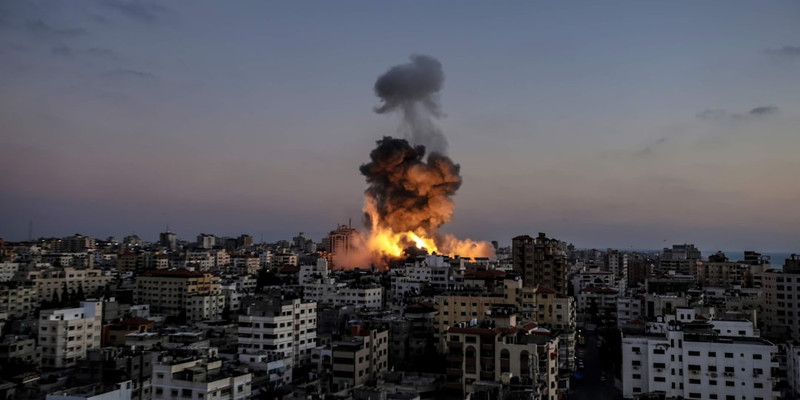
Gaza - Palestine A huge explosion in a building as a result of a bombing by Israeli warplanes by Mohammed Ibrahim is licensed under Unsplash unsplash.com
