In 1832, Senator John C. Calhoun of South Carolina articulated a doctrine that he believed was constitutionally sound, philosophically coherent, and politically necessary: that individual states retained the sovereign right to nullify — to simply refuse to obey — any federal law they judged to be unconstitutional. The theory was elegant. The consequences were catastrophic.
Within three decades, the logic embedded in Calhoun's nullification doctrine had mutated into secession, secession into civil war, and civil war into the deaths of more than six hundred thousand Americans. The republic survived, but it survived only because a majority was willing to pay an almost incomprehensible price to establish, once and for all, that the Union is not a compact that can be dissolved at will by its constituent parts.
One might have assumed that lesson was learned.
This week, the Hawaii Supreme Court issued a ruling that has been described, with some understatement, as "declaring war" on the United States Supreme Court. The case — Granillo v. State — represents what The Federalist has characterized as planting "seeds of a nullification crisis," with observers warning that other courts may follow Hawaii's example. The specific contours of the ruling are, in some sense, secondary to the principle it embodies: a state court aggressively targeting and implicitly defying the authority of the federal judiciary.
What the Hawaii court has done is not unprecedented in American legal history. It is, in fact, precisely what the Supreme Court addressed in Cooper v. Aaron in 1958 — unanimously, and with deliberate and unusual force. In that case, all nine justices signed the opinion personally, an extraordinary gesture designed to make unmistakably clear that the holding was not the view of a majority but the law of the land. Their conclusion was this: federal constitutional interpretation, as exercised by the Supreme Court, binds every state court, every state official, and every state legislature in the country. There is no reserved power of state judicial nullification of federal constitutional rulings. There never was.
Thucydides, describing the dissolution of civic order in Corcyra during the Peloponnesian War, wrote that when the bonds of shared norms break, the words themselves change meaning — what once meant justice now means weakness, and what once meant restraint now means complicity. We are not yet at Corcyra. But we would be foolish not to recognize what is happening when courts begin declaring independence from the supreme court of their own constitutional order.
There is something worth naming clearly here. The impulse that drives Hawaii's ruling — the impulse to say, in effect, "we know better, and our reading of the Constitution supersedes yours" — is precisely the impulse the Founders anticipated and feared. James Madison, who knew something about state sovereignty having authored the Virginia Resolutions, spent the latter portion of his life disavowing the interpretation that his earlier writings gave any state the right to unilaterally override federal law. The Constitution created a federal judiciary precisely because the Framers understood that a republic of fifty separate legal regimes, each empowered to ignore the law it disfavored, was not a republic at all. It was, at best, a loose confederation. At worst, it was a prelude to dissolution.
Tocqueville, arriving in America in 1831 — the very year Calhoun was refining his nullification theory — observed that the genius of the American system was not merely its democratic spirit but its legal architecture: a federal judiciary capable of mediating conflicts between the states and the union, and an implicit shared commitment among the governed to accept the results of that mediation. Take away that commitment, and what you have is not self-governance. You have factions, each claiming the authority of law while recognizing no law above their own preferences.
The permanent things — rule of law, constitutional hierarchy, the peaceful resolution of legal disputes through established processes — are not exciting. That is partly why they are so difficult to defend. The drama is always on the side of defiance. The rebel court, the nullifying legislature, the governor standing in the schoolhouse door: these make for compelling theater. The patient, grinding work of constitutional order does not.
But the permanent things are what make civilization possible. Western legal tradition, rooted in centuries of natural law theory and refined through the extraordinary experiment of American constitutionalism, holds that the authority of law derives not from the power of those who enforce it, but from the consent of those who are governed by it and the legitimacy of the process by which it is established. When a state court begins to unilaterally reinterpret or simply reject the authority of the nation's highest tribunal, it is not asserting a competing interpretation of law. It is asserting that there is no law — only power, and whichever institution holds the most of it in a given moment.
The concern raised by The Federalist — that other courts may follow Hawaii's lead — is not alarmist. It is historically informed. The logic of nullification is contagious precisely because it flatters the defying party's self-image. Who among us does not believe that our judgment is correct and our adversaries' is corrupt? The question is whether institutions exist that bind us to processes larger than our own certainty. The Constitution, properly understood, is exactly that institution.
What is most troubling about the Hawaii ruling is not that one state court has overreached — state courts overreach with some regularity, and the appellate process exists to correct them. What is troubling is the characterization: that it represents an aggressive targeting of the Supreme Court itself, that it is explicitly framed as a counter to federal judicial authority rather than an interpretation of it. That is different in kind from ordinary legal error.
Calhoun thought he was defending constitutionalism. He was destroying it. The South Carolina Exposition and Protest, like many revolutionary documents, was written in the language of preservation while advancing the logic of dissolution. The defenders of nullification always believe they are the last guardians of a principle. They rarely notice that the principle they are guarding has already collapsed around them.
The republic has survived nullification crises before. It has done so at great cost, and only by affirming, repeatedly and sometimes at great price, that the constitutional order is not optional. That lesson should not need to be relearned. But if other courts take Hawaii's lead — if Granillo v. State becomes not an anomaly but a template — we may find ourselves in precisely the position of having to relearn it.
The seeds have been planted. Whether they take root is a question that depends on whether those entrusted with guarding the constitutional order treat this moment with the gravity it deserves.
History does not look kindly on institutions that planted the seeds of nullification and then expressed surprise at what grew.
Hawaii's Supreme Court Just Declared War on the Federal Judiciary. History Tells Us Where This Leads.
- by:
- 07/23/2026
- Source:
fafodispatch.com

- 07/23/2026
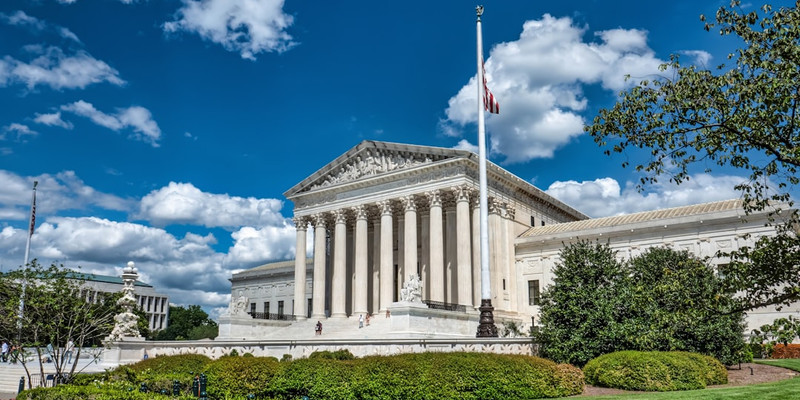
the supreme court of the united states in washington, dc by Stephen Talas is licensed under Unsplash unsplash.com
